Puff Pastry Cheese Straws
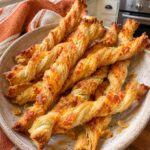
Puff pastry cheese straws bring flaky layers, sharp cheddar and Parmesan together in a finger food that feels right at home on a party platter. The twists give you crisp edges and little folds of cheese throughout, with deeply golden pastry that makes each straw as appealing to look at as it is to eat.
You can serve them warm or at room temperature, making them an easy fit for an appetizer spread. The details that matter most are keeping the pastry cold, helping the cheese adhere and letting the centers bake fully.
Cold Pastry Makes Shaping Easier
Frozen puff pastry needs to be flexible enough to unfold without cracking while still feeling cold. Follow the thawing guidance on the recipe card or your package, and pay attention to how the dough feels. Pastry that resists unfolding needs more thawing; pastry that feels soft or sticky needs refrigeration before you continue.
A light dusting of all-purpose flour helps keep the pastry from sticking as you roll. Aim for an even rectangle so the strips are consistent. Keeping the dough cold as you work helps preserve the distinct layers that give the finished straws their flaky texture.
Help the Cheese Stay on the Pastry
Sharp cheddar gives these straws their pronounced cheese flavor, while finely grated Parmesan adds another savory note. Freshly shredded cheddar should be fine enough to settle against the pastry instead of sitting in bulky clumps. An even scattering gives you cheese across the surface without leaving heavily covered patches beside bare dough.
The egg wash needs only a light touch; you may have some left over. Gently rolling over the cheese beneath parchment presses it into the pastry. This helps it stay attached when you cut and twist the strips. Freshly ground black pepper finishes the topping without competing with the cheeses.

Shape Even Twists Without Losing the Topping
Even strips are easier to shape consistently and help the batch bake evenly. Twist the ends in opposite directions, handling the pastry gently so you keep the cheese in place. If some cheese falls away, press it back onto the strips rather than leaving it scattered across the baking sheet.
Pressing the ends lightly onto the parchment helps the twists hold their shape. Leave space between the straws so they have room to puff, and follow the recipe card’s chilling guidance before baking. If shaping has made the dough soft or sticky, refrigeration is especially helpful.
Look Beyond Golden Cheese for Doneness
The cheese can look ready before the pastry centers are fully baked. Look for puffed layers, deeply golden edges and crisp undersides, along with centers that appear dry. Rotating the baking sheet as directed helps the straws brown evenly. Use the recipe card’s guidance if the centers need additional baking.
Let the finished straws cool on the baking sheet as directed before moving them to a platter. Their crisp pastry and savory cheese make them easy to enjoy warm or at room temperature.
Frequently Asked Questions
Why does my puff pastry crack when I unfold it?
Cracking means the pastry is still too firm to unfold easily. Let it thaw according to the package or recipe card until it opens without breaking. You want flexible dough that still feels cold, so check its texture as you go.
Do I need to use all the egg wash?
You may not need all of it. The pastry needs a light brushing before you add the cheese and pepper. Focus on a thin, even coating, then use the parchment and gentle rolling pressure to help the topping adhere.
How can I tell whether the centers are baked?
Check the pastry itself as well as the cheese. The straws should be puffed and deeply golden, with crisp bottoms and centers that look dry. If the middle still looks underbaked, follow the additional baking guidance on the recipe card.
Puff Pastry Cheese Straws
Twisted puff pastry straws bake into flaky layers with sharp cheddar, Parmesan and deeply golden edges. Serve them warm or at room temperature as an easy finger food.
6
servings15
minutes22
minutes265
kcal1
hour37
minutesIngredients
1 sheet frozen puff pastry, approximately 8.6 oz
1 tbsp all-purpose flour, for rolling
1 large egg
1 tsp water
1 cup freshly shredded sharp cheddar cheese, approximately 4 oz
1/4 cup finely grated Parmesan cheese, approximately 1 oz
1/4 tsp freshly ground black pepper
Directions
- Thaw the puff pastry at room temperature for about 40 minutes, or according to the package directions, until it unfolds without cracking but still feels cold.
- Line a large baking sheet with parchment paper. Lightly flour a work surface and roll the pastry into a 10×12-inch rectangle. Beat the egg with the water in a small bowl.
- Brush the pastry lightly with the egg wash; you may not need all of it. Scatter the cheddar, Parmesan and black pepper evenly over the pastry. Cover with another piece of parchment and gently roll over it to press the cheese into the surface. Remove the top parchment.
- Cut the pastry into 12 strips, each 1 inch wide and 10 inches long. Hold both ends of each strip and twist in opposite directions 3 or 4 times. Arrange on the prepared baking sheet with about 1 inch between the straws, pressing the ends lightly onto the parchment to help hold their shape. Press any loose cheese onto the strips.
- Refrigerate the shaped straws for 15 minutes. While they chill, preheat the oven to 400°F with a rack in the center.
- Bake for 22 minutes, rotating the baking sheet halfway through, until the pastry is puffed, deeply golden and crisp underneath. If needed, bake for an additional 2 to 3 minutes until the centers look dry and fully baked.
- Let the cheese straws cool on the baking sheet for 5 minutes before transferring to a serving platter. Serve warm or at room temperature.
Notes
- Keep the pastry cold while shaping. If it becomes soft or sticky, refrigerate it briefly before continuing so the layers stay distinct.
- Use finely shredded cheese so it adheres readily to the pastry.
- For the crispest texture, serve the straws the day they are baked. Reheat leftovers in a 350°F oven for 5 to 7 minutes.
- The timing includes 40 minutes for thawing, 15 minutes for chilling and 5 minutes for cooling. Follow your pastry package if its thawing instructions differ.